
A quest to slow down: transition to low-tech devices
Updated: Jul 11
Here are my further thoughts regarding this topic that I was invited to provide inputs on for Lianhe Zaobao 联合早报 recently.
In the current society, it is common that individuals are armed, by default, with high-tech electronic products. Despite this being a common occurrence, the stakes are high - namely, high levels of overwhelm, stress and anxieties among users.
Fear of missing out in today’s society can underlie individual's chase after the latest gadgets and need to stay updated with tech trends. This inevitably adds sense of overwhelm and stress to lives of these individuals. Though the latest functions in the devices are intended for convenience, users may need to adjust to the changes and this, at least in the initial phase of introduction, can elicit sense of overwhelm and/or anxiety.
The higher tech devices are often associated to the societal expectations imposed on users to stay “on top of things” and provide quicker response in light that everything is at one’s finger tips (both literally and figuratively speaking). As such, this can pose unnecessary added stress on users.
Given the above, individuals may consider the reduction of tech-use or engage in digital detoxification. Personally, I see digital detoxification as a voluntary break from the modern high-tech life characterised by the information overload, screen fatigue, and endless notifications.
As individuals spend less time on their electronic devices, it can translate to more time for other activities be they solitude activities and/or social interactions, which can support stress management. Additionally, reduced exposure to phone use, for example, means that there will be lower exposure to blue light emission which can aid sleep. Improved sleep can in turn, support stress management. (Do check out my previous blog entry on sleep here)
Studies have found that when one starts the day by consuming social media feeds or news, which can be mostly unpredictable, it can influence one’s mood and stress levels for the day. For example, if users are exposed to unfavourable news at the start of the day, this can negatively affect their mood for that day.
On the contrary, reduced phone use can create stress for individuals too, especially if they were reliant on phone activities (e.g., games) for stress-relief. I imagine these individuals may feel lost and helpless until they begin expanding their stress-coping repertoire to include in-person or off-line activities such as journaling, boardgames or going for a walk.
The transition to low-tech electronic products and its benefits on mental health
This is a topic that is relatively close to my heart. The transition to low-tech feels familiar to me personally. Here’s why - I belong to the Millennial generation (also known as Gen Y). I am familiar with film camera, walkman, CD players and low-tech phones and even pagers. I hope I haven’t lost you at this point.
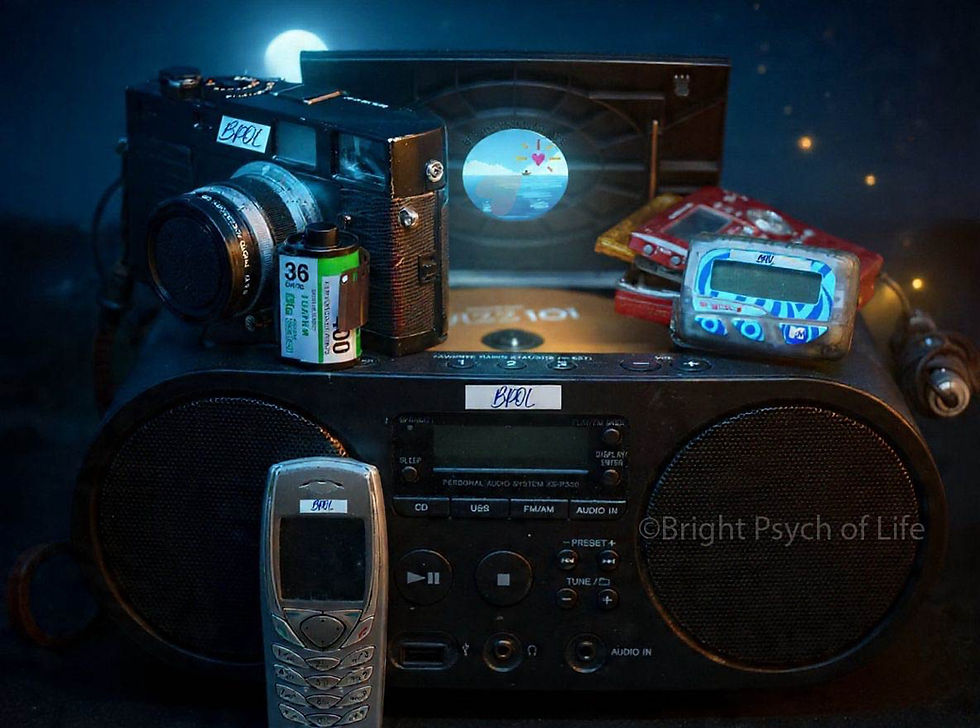
My generation experienced the introduction of internet, powered by dial-up technology. Do you recount the screeching noise and several minutes taken to load a single image? Essentially, we witnessed the technological evolution from the start of mobile phones (i.e., the size of bulky 500ml bottles) to the high-tech smart devices and artificial intelligence (AI) platforms of today. Now, I still enjoy using the low-tech devices such as CD and vinyl players for music and film camera for photography. These vintage products help me achieve a higher level of intentionality and focus on the present moment. As said, there are numerous mental health benefits associated to the use of low-tech products:
Mindfulness
Specifically, the step-wise repertoire of tactile actions involved in operating “low tech electronic devices, such as CD or vinyl players, require users to slow down and focus on one given task (e.g., ensuring that CD is loaded precisely into the given tray) at a time. This connects us to the present moment (mindfulness) and “anchors” us, which can potentially calm nervous system, lower stress hormones and regulate distress.
Greater sense of agency and peace
The use of high-tech devices involves exposure to digital streaming and social media, which can bombard users with notifications and suggestions. And this inevitably creates overwhelm among users. Hence, when one does digital detoxification, exposure to the above becomes reduced, and this brings peace to users. Since the entertainment functions in low-tech devices are relatively limited, users can experience a greater sense of agency and control over their time and attention which they can utilise for other activities.
Greater opportunity for social connection
Using physical media, e.g., CD or vinyl players, can create a shared (physical) space in which individuals can gather to listen to music and look at physical lyrics together, with minimal disruption (e.g., from calls, messages etc). As participants listen to songs from different eras, this serves as opportunity for exchanges involving their lived experiences and stories. This helps to keep history alive and bridge generational divide (if any). Such social connections can reduce feelings of isolation, boosts one’s sense of purpose and identity and support emotional regulation.
Importance of slowing down
Slowing down effectively switches our body from “fight or flight” to “rest and digest” mode, which in turn reduces cortisol (stress hormone) levels, lowers heart rates and signals to brain that we are safe in the present instance. Given that slowing down has the said benefits on mental health, here are considerations to apply to your life.
i) Single tasking (as opposed to multi-tasking) involves, doing one task at a time in a protected/limited time period e.g., playing a round of board game, or joining a group-based exercise or activity.
ii) Use of mindfulness focus
Examples include mindful walks like colour walks, and/or mindful eating.
Check out my previous Lianhe Zaobao interview where I gave inputs on mental health impact of colour walks, among others.
However, any form of change (s) can potentially be stress-inducing. In the case of transition to low-tech, when one uses a film camera, one can only view the end product after the entire roll of film is developed. This is unlike a phone camera in which users can review the photo immediately after taking it. Such delayed gratification can create stress especially in users who are too used to immediately getting what they want, which can be a typical expectation in today’s technologically advance world.
In addition, switching to low tech products can involve losing not just one’s “virtual identity” but also, instantaneous connection with online community. Such loss(es) can create void for users, and elicit sense of grief and distress.
Thus, In order to buffer these negative impact on individuals, one can consider the transitions in phases, and in gradual manner. Do consider that there is no one fixed way of doing this transition and embark on it at your own pace that suits your lifestyle and values. And know what you can engage in support if need be, to learn how to stay and sustain in the journey towards change.
In conclusion, the endeavour of slowing down and stress management can be zero-cost and fuss-free! It may involve, engagement with nature such as cloud watching and colour walks, or engagement with people and group-based activities e.g., boardgames or listening to vinyl music together. Having a variety of stress coping strategies can be helpful as this provides option and maximises our capacity to cope in any given situation.
Where the use of tech products is concerned, do be reminded that moderation is the key and recognise that you are an active change-agent. You do not have to settle for status quo, especially if it is not serving you - instead, you decide what you direct your limited time and attention to, and review the extent of tech in your life, according to your life values and goals.
If you are struggling with transition or in slowing down or simply wish for assistance in being the change-agent to take action towards a balanced and meaningful life, do reach out for support by emailing contact@brightpsychoflife.com.sg or dropping a note here!
Rooting for you as always,
Jeanice


Comments